

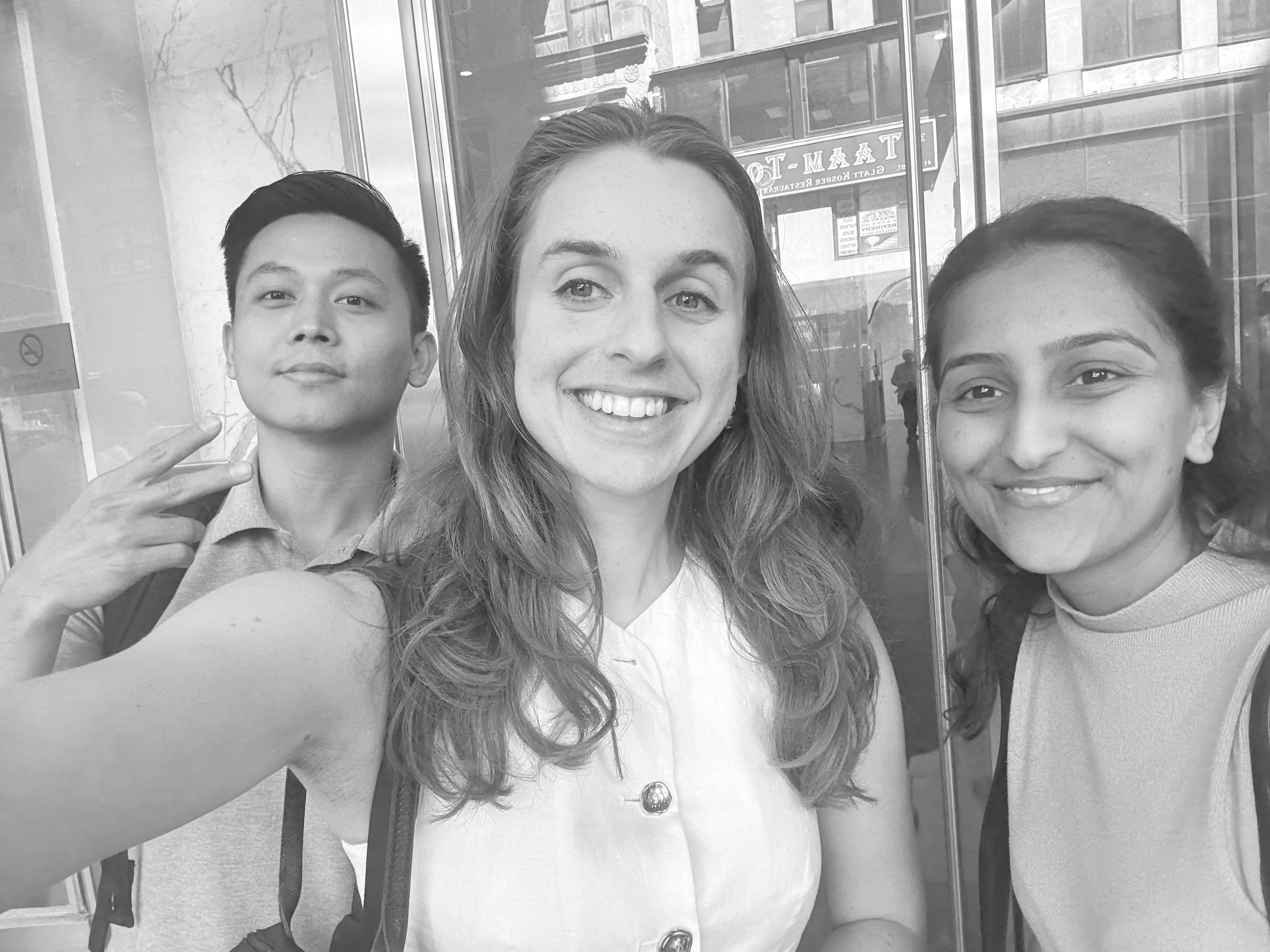
It’s the middle of July. New York is hot, and I’m there that week for a course at the Gemological Institute called Gem Identification.
The objective is to learn how to use the tools needed to identify gems—in simple terms, conducting a series of tests to know that a sapphire’s a sapphire or a ruby’s a ruby.
I’ve become comfortable with the school and the Diamond District in New York, as this is my third trip to the city in the last few months. The first time I was there in March, I made a friend in my diamond course named La Min. He’s originally from Myanmar, where his family runs a jade farm, and moved to New York five years ago to work at the International Gemological Institute (IGI).
The second time we met, he insisted on buying me lunch because by chance we ended up in the same course. This time, I’ve intentionally signed up knowing La Min will be there, and I sit beside him at the back of our class of 20. Next to him is someone new—her name is Urvashi.
“Do you want to get lunch together?” she says to La Min when it’s noon time.
The three of us eat in the courtyard near the school. I’m surprised to discover that even as an adult, the classroom acts as a quick way to make friends. Maybe it’s how closely we sit to one another or the fact that we share similar interests—probably it’s because there is an immediate bonding when learning together.
Urvashi tells us that she moved to New York in 2013 from Thailand. “Finding friends was not particularly easy because New York is very different than home,” she says.
She was 18 at the time and explains that in Thailand, and especially at school, “there was a lot more culture.”
“At my school, there were a lot of Koreans, and not everyone understood what goes on in Indian culture, but we made an effort to participate in each other’s holidays throughout the year,” Urvashi says.
“I have a love-hate relationship with New York. Initially, I didn’t believe I would ever get used to it, but my dad stayed in New York for a couple of years, building his business, and assured me that it was the land of opportunities. I didn’t believe it because I was missing home, the food, the weather, the people.
Thai people are soft and nice,” she says.
In New York, she had to toughen up and get comfortable with the cold. As the years passed, the big city became home.
Over the five-day course and daily lunches, we left feeling like friends.
“Come stay with me the next time you’re in New York,” she said.
In the months since then, we stayed in touch on social media, had a few phone calls, and exchanged pictures of gemstones.
We caught up thoroughly a few weeks ago.
“What was it like growing up in the gem industry?” I ask Urvashi. Her father is a gem dealer, but she wanted nothing to do with his field until recently.
“I took it for granted. But now I see his passion come through, and I want to know, ‘How is business?’ or ‘What is this?’”
She’s just come back from two months in Thailand, where she shadowed her father and went to the countryside to source stones and see how roughs are converted to cut stones. “That aspect was very interesting. Seeing something evolve from being a rough to being set in jewelry,” she says.
We’re both glad we’ve found ourselves in this industry, me through my uncle’s influence and Urvashi’s through her father.
“Women don’t go to the mines,” she says. “But I did tell my dad, I really want to go look at actual mines. There are still some old ways that they mine these gemstones. The books can only show you so much; you have to go and see it.”
As a curious risk-taker, I relate to Urvashi.
“Was it difficult to build a life in New York?” I ask.
“When I came here, I never really knew what was going on in someone’s life. If I felt homesick, I knew a lot of people, but I realized I was actually kind of alone,” she says of her time in university.
“To me, a true friend is someone who is there in the good and bad times. I expect to be there for them in their bad times. I was part of their good times, but not part of their bad times. What kind of friendship is it if we go on vacation or spend a weekend together, but in someone’s bad times, I can’t be there for them?”
There is a certain closeness built when we see someone at their worst or when they see us at our worst, and we’re able to get through it together. A trust is created when we’re accepted and supported in these circumstances. But do we all value that side of friendship?
“When I came back to the GIA for the diamond course, I couldn’t find people to go to lunch with,” says Urvashi. “I quickly asked, but everyone seemed to have their own plans.”
“That’s interesting because I hate eating alone,” I say. I begin to think that maybe I had just been lucky in the classroom.
“If we don’t tell our own stories, no one else will.”
—Mira Nair